The Natural Death CentreToday (19.03.2026) the Gosport families along with the NDC are launching a new reporting service RYFE. If you know someone who has had terrible or unsatisfactory experience of any funeral director and has found nowhere to go to report it, please let them know that now they can do just that.
Here is the page from the new RYFE website:- https://www.ryfe.uk/
Report Your Funeral Experience07719 70219507803 18643307523 847263We are really sorry to hear that you have been let down. The Gosport families, neglected by jailed undertakers Elkin and Bell, and the Natural Death Centre charity have joined forces to offer this interim facility until the Government act to licence, regulate and monitor the funeral industry. We understand that at present there is nowhere to go when poor service is received from a funeral director. We have set up RYFE to ensure that whoever the future regulator is, that they understand the scale and nature of the neglect and maladministration that is currently occurring. We also welcome insights from whistle-blowers who have witnessed poor practice. Historic experiences are welcome too. We appreciate how guilt and trauma can last for years when poor service is experienced by the bereaved. We cannot remedy your individual issue but will record what has happened and will pass this information to whichever Government dept or organisation they task with regulating funeral provision and the care of our dead. Please phone to speak with one of our RYFE volunteers, 07719 702195 or 07803 186433 Together we will change funeral provision for the better.
VIRUS RELATED INFORMATION All our burial grounds are open for funerals. Why are we still flagging up covid issues? Because it is a perfect example of how the unregulated funeral industry is open to poor and in some cases criminal practice. Caveat emptor, do your research and read on. Be Careful ! We are sorry to report that some funeral directors are still not caring for the bodies of the dead in the way most families expect. Do not presume. They are not opening or removing people from body bags, in particular those that have died in hospital from Covid 19. Consequently they are not removing hospital apparatus like breathing tubes or catheters. The dead are not being washed or dressed and families are being denied the opportunity to take keepsakes like locks of hair or fingerprints. They are following their own company's emergency policy, not guidelines from the World Health Organisation, Public Health England or the Royal College of Pathologists. The WHO, PHE and the RCOP state that body bags are not required as long as the correct PPE is worn and a face mask is placed on the deceased to prevent any aerosol generation when the body is being handled. We suggest a biodegradable mask or the whole face could be covered with a couple of layers of natural fabric, such as cotton towelling. The risk of infection is from the living not the dead. If a funeral director tells you that you cannot view the body, "you must cremate" or if they start citing rules and regulations we suggest that you jump ship to another company who will look after your relative in a more respectful and courageous manner. We have witnessed one large company use incompatibly coded, foreign, H&S information as a scare tactic. In another situation, one poor gentleman who had bought his burial plot 10 years ago died from Covid19. He really didn't want to be cremated but the undertaker told his wife that he "could not be buried." Unfortunately she did not check with the cemetery who would have told her to use another funeral director. This was probably because the undertaker knew that the burial ground would not allow a body, still in a plastic bag, to be buried. As they have always done, some firms are using the pandemic as an excuse to take on more work than they can cope with. This has resulted in families being told that “due to the pandemic” there is no availability at the cemetery or crematoria for several weeks. This is mostly untrue. Delays are down to them being too busy and having no vehicles or staff available.
Always ring the cemetery or crematorium yourself to find out about availability. During the pandemic, one family who rang us were told that there was a 9 week wait for a burial at their local cemetery in London. A call from us discovered that there were 3 teams of gravediggers working tirelessly and an immediate burial was available. The NDC can send you information about arranging a burial on private land and offer you advice on carrying out DIY funerals. The Natural Death Centre remains open for all enquiries please ring 01962 712690 or 07719 702195. email contact@naturaldeath.org.uk. ------------------------------------------------------------------------------------How can we help you?If you are looking for help, support, advice or guidance planning a funeral, either for yourself or for someone close to you, the Natural Death Centre Charity is here for you.
We are passionate about sharing knowledge, dispelling myths, and empowering everyone who wants to have the best experience possible when it comes to making arrangements for a funeral.
We firmly believe that knowledge is power, and that by knowing what is possible, you will be able to make informed choices about what is right for you, your family and for the person who has died.
Please look through the pages of this website, or call our Helpline if you would like to speak to somebody who will give you as much time as you need.
Arranging a funeral If you have to organise a funeral, or need help with a funeral, please look at our Arranging a Funeral section. Here you will find all the information you need to help you organise a good funeral, along with information about how to buy funeral services or funeral products.
If you are about to make arrangements for a funeral you might find our free download Questions to ask a funeral director useful.
If you want to find an funeral director, or want to know what makes a better funeral director, please look at our Funeral Directors page. Here you will find information about how to find a good undertaker, and details about funeral directing companies that are flexible, transparent and fair. If you need an undertaker to help you with a funeral, we feel it is essential to do some research about the values of the company before appointing one.
If you are considering a green burial we have some suggested Questions to ask a woodland burial site to help you ascertain just how green and environmentally responsible a site is.
If you want to buy a coffin, please look at our Coffins, Shrouds and Memorials page. These are all Eco-coffins (green coffins) made by coffin suppliers who will sell directly to the public. They are generally alternative coffins made from willow or cardboard, however there are a few manufacturers of solid wood coffins who will sell direct as well as to the funeral trade.
Detailed guidance and information about having more control of funeral arrangements is contained in our Information Pack, available free if you join The Natural Death Society - details here
The People's Awards forThe Best Natural Burial Ground in the UK In keeping with our belief that kindness, support, empowerment and information is what every bereaved family needs, we used the information contained in over a thousand feedback forms from families who chose a natural burial to select the winners in our unique People's Awards.
Find out more here
Independent funeral adviceIn the 34 years since the charity was founded in 1991, the Natural Death Centre has sought to inform, empower and inspire the public in all matters relating to death and dying, and in particular to increase awareness of funeral choices outside of the mainstream. Despite our long running links with environmentally friendly funerals, we are not a green pressure group, but primarily a movement for social change. We have played a central part in demystifying the traditional funeral, encouraging thousands of families in having the kind of funerals they wanted, and helping create opportunity for new rituals to emerge. We are, and will continue to be an informed and reflective presence on issues such as dying at home, caring for our dead and changing funeral practices and we actively promote natural burial as an option that should be offered to everyone.
The Natural Death Society
Why don’t you join The Natural Death Society?
How you can help us
Our work is only possible through the generous support of people like you.

  The Natural Death Handbook (Fifth Edition)
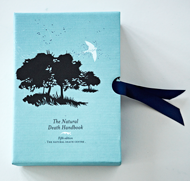
The latest edition of the Natural Death Handbook is now available for anyone seeking advice on caring for someone who is dying or who wants to find out more about choices in funerals. Packed with timeless information which has helped to change the way we look at death, this ground breaking work continues to inspire and empower families across the world. We have chosen to sell the books EXCLUSIVELY directly from the Charity to prevent major online distributors from profiting at our expense. Packed with timeless information which has helped to change the way we look at death, this ground breaking book continues to inspire and empower families across the world. Read more here
Click here to read a review on the Huffington Post: Death's Summer Coat: A Review of The Natural Death Handbook, Fifth Edition
Natural Burial GroundsThe Natural Death Centre also runs the Association of Natural Burial Grounds, the organisation which sets the standard for the growing number of green and environmentally friendly cemeteries in the UK. All of our members undertake to comply with the ANBG Code of Conduct and take part in our independent monitoring system, giving families the ANBG Feedback Form to complete and return to the NDC. To find your nearest ANBG natural burial ground please click here to see our list of members.
Death Plan and Funeral Wishes FormsThe Natural Death Centre provides a Death Plan form and a Advance Funeral Wishes form which can be downloaded on the links above. You can also watch videos of people talking about their own experiences of end of life care and living with a terminal illness on the 'Living with Dying' section of the healthtalkonline website.
|
|
The New Natural Death Handbook fifth edition is out now, this book is a must read for everyone. Completely revised and expanded into a boxed set of three books... Read more
Credit to Will Whipple (photographer) ______________
Links and Resources
|
Home | Contact us | Log in | Donate 
Registered Charity
Number. 1091396
Helpline: 01962 712 690
Normal call rates apply